

A low asking price doesn’t make a liquidation pallet a sound purchase. To determine how to evaluate liquidation pallets, look beyond the listing and assess whether the available evidence, inventory condition, freight costs, and resale potential support a defensible decision.
A manifest may not show how much testing, sorting, repair, or storage a mixed lot will require. Freight can also change the economics before a single item reaches a sales channel. Even familiar categories may include goods that don’t suit your buyers, processing capacity, or cash-flow limits.
This guide provides a repeatable pre-purchase checklist for reviewing listing details, assessing inventory fit and condition, accounting for landed costs, and estimating resale viability without relying on optimistic assumptions. You’ll also learn how to identify gaps in the available information and decide when those gaps make a purchase premature. Whether you’re considering tools, appliances, electronics, apparel, or other wholesale inventory, the goal is to estimate both the opportunity and the work required to realize it.
Key Takeaways
- Use a consistent process for how to evaluate liquidation pallets, starting with buyer fit and listing evidence before estimating resale potential.
- Separate item-level manifest details from estimates and assumptions so you can spot material gaps in the listing.
- Compare the stated condition with the testing, sorting, and preparation your operation can realistically handle.
- Build a landed-cost worksheet that includes freight, handling, storage, and expected sellable units, not just the purchase price.
- Record open risks and your decision rationale in a go-or-no-go checklist before committing to a pallet.
How to Evaluate Liquidation Pallets Before You Commit
Assess the listing evidence, fit with your operation, and total financial exposure before considering projected resale upside. A pallet’s stated retail value is not the amount you’re likely to recover. Retail figures may reflect original selling prices, while your actual proceeds depend on condition, completeness, customer demand, selling fees, and the time needed to prepare each item for sale.
Contents and processing demands can vary by lot, even within a familiar category. A pallet of electronics, for example, may include units that need testing, accessories that must be matched, or products that don’t suit your current sales channel. For foundational context on the broader term, see What is Liquidation?
Evaluate a liquidation pallet as a documented purchase decision, not a guess about value.
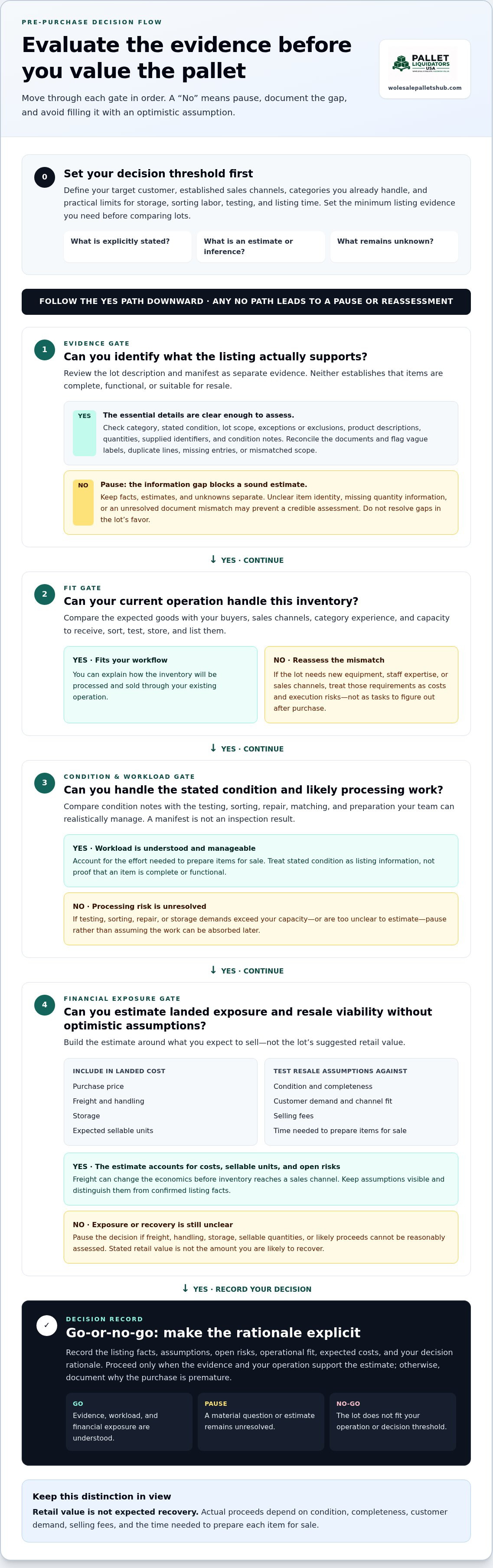
Record what the listing states, what you can reasonably infer, and what remains unknown. If you can’t explain how the inventory would be processed and sold through your existing operation, a high suggested retail value won’t resolve the gap.
Start with your resale operation, not the listing
Define your target customer, established sales channels, and categories your business already handles before comparing lots. A reseller experienced in apparel may have established processes for grading and listing clothing, while a mixed pallet containing small appliances or power tools could require different product knowledge and testing capacity.
Set practical limits for storage space, sorting labor, testing, and the time available to list inventory. Separate products that fit your current workflow from goods that would require new equipment, staff expertise, or sales channels. Treat those added requirements as costs and execution risks, rather than assuming you can take them on after purchase.
Define a purchase decision threshold
Set minimum evidence requirements before reviewing a prospective lot. These might include an itemized manifest, quantities, a clear condition description, and stated exceptions. Your threshold should reflect the category and your risk tolerance: unfamiliar or test-intensive goods may require more detail than inventory you already know how to grade and sell.
Then distinguish manageable unknowns from decision-blocking gaps. Uncertain packaging may be manageable if your pricing allows for inspection and repacking. Unclear item identity or missing quantity information may make a credible estimate difficult. Record assumptions separately from listing facts so estimates don’t become mistaken for confirmed details.
- Listing evidence: What details are stated explicitly, and what is summarized or estimated?
- Operational fit: Can your team receive, sort, test, store, and list the expected inventory?
- Open risks: Which unanswered questions could materially change your decision?
Apply the same threshold to each lot under consideration. If essential evidence is missing, pause the comparison instead of filling gaps with the most favorable assumption. This gives you a defensible starting point for examining the manifest and listing details more closely.
How to Assess a Liquidation Pallet Manifest and Listing
Read the listing and manifest as separate pieces of evidence. The listing describes the lot being offered, while a manifest may provide more detail about its contents. Neither document alone establishes that the listed goods are complete, functional, or suitable for resale. A manifest is evidence about listed contents, not a guarantee of resale results.
To understand how to evaluate liquidation pallets at the document level, follow a consistent review sequence and note where the information stops supporting an assumption.
- Read the full lot description. Identify the category, stated condition, lot scope, and any exceptions or exclusions. Note whether the description refers to the specific pallet or gives only a general summary.
- Review the manifest fields. Check product descriptions, quantities, identifiers such as model or item numbers when supplied, and condition notes. Ask whether each entry is specific enough to distinguish an individual item from a broad product type.
- Reconcile the documents. Compare the manifest’s stated scope and listed quantities with the lot description. Flag missing entries, duplicate lines, vague labels, or details that appear inconsistent. Don’t assume the documents account for unlisted items or explain an unstated exception.
- Mark evidence and inference separately. Record what the documents explicitly say, what you estimate from them, and what remains unknown. Keep category summaries and suggested values distinct from item-level facts.
Read the manifest for usable inventory evidence
A description such as “small kitchen appliance” may be too broad to estimate listing effort or channel fit. A more specific item description and quantity can help with sorting and planning. Even item-level details have limits: an identifier can help distinguish products, but it doesn’t establish that a unit is complete or functional. Treat condition notes as stated information, not as inspection results.
Flag discrepancies for review rather than resolving them in the lot’s favor. If a manifest lists quantities but the lot description defines a different scope, document the mismatch and consider whether it prevents a sound estimate. The aim is not to infer missing details, but to determine whether the information available is adequate for your decision.
Evaluate manifested and unmanifested information
Item-level information can support a more specific sorting plan, but it leaves condition, completeness, and customer demand uncertain unless those points are documented separately. Category-level details in an unmanifested lot may still help a buyer with relevant sales channels and tolerance for greater uncertainty, but they provide less basis for estimating the mix of individual items.
Use the same standard for both formats: identify which facts are documented and which remain assumptions. The difference is how much visibility each format gives you into individual items, quantities, and the work involved in processing the lot.
If your question concerns the tax considerations of a business closure rather than the contents of a pallet, the IRS Guidance on Business Liquidation addresses that separate context. Once your document requirements are clear, compare them with available pallet and bulk inventory without treating a manifest as proof of resale value.
Assess Pallet Condition, Category Fit, and Processing Needs
Condition labels are useful only when you distinguish what the listing states from what you still need to establish. A description such as “new,” “shelf pull,” “customer return,” or “salvage” does not by itself confirm that an item is complete, clean, functional, or ready to list. Treat these terms as starting evidence, not inspection results.
For each condition statement, record what it tells you and what remains unknown. A product described as new may still need packaging review; a return may require testing; salvage merchandise may need sorting to identify items that can be sold. These uncertainties affect processing time and the share of inventory that may fit your sales channels.
Interpret condition information without overreading it
Separate stated condition from assumptions about testing, completeness, packaging, and functionality. Estimate the work required for inspection, cleaning, repackaging, or disposal where relevant, and include it in your evaluation. Retail packaging and a detailed product description are not proof that an item works. For explanations of condition-grade terminology, refer to a dedicated condition-grades guide rather than treating labels as universal.
| Condition evidence | Likely processing | Resale-channel implication |
|---|---|---|
| Listing states new or shelf pull, without item-level inspection details | Check packaging, completeness, and visible damage | May suit channels that accept the observed condition, subject to verification |
| Listing identifies customer returns | Sort and test items; assess completeness and damage | Plan for individual condition descriptions or exclusion of unsuitable units |
| Listing describes salvage or visible damage | Assess each item for repair, parts value, or disposal | Proceed only if your channel and handling capacity support variable outcomes |
Use the table as a planning aid, not a fixed grading system. Seller terminology and the evidence behind it can differ, so base your processing estimate on the actual listing details and your experience with the category.
Match merchandise to your sales and handling capabilities
Compare the lot’s categories with established customer demand and the channels you already use. A category may look attractive yet create additional work if your team lacks the knowledge to assess it, the space to store it, or the process to list it accurately. Category fit depends on buyer access and operational capacity as much as product type.
Consider the handling profile of each category. Electronics and small appliances may require testing; apparel and footwear may need sorting by size, style, or condition; tools and home improvement goods may call for item-specific inspection and storage. Treat these as planning considerations, not assumptions that every unit will require the same work.
- Fits current operations: You understand the category, have a suitable sales channel, and can process the expected volume.
- Requires added capacity: You need more storage, testing, research, or labor than your current workflow supports.
- Creates material uncertainty: You can’t assess demand or handling requirements well enough to estimate the work involved.
Use these distinctions to decide whether a lot fits your business as it operates today. An unfamiliar category isn’t automatically unsuitable, but the research and capacity it requires should be explicit in your evaluation of how to evaluate liquidation pallets.
Calculate Landed Exposure and Test Resale Viability
A lot can look viable at its purchase price and become uneconomic after inbound freight, receiving, inspection, and sales costs are included. Build your calculation around what you expect to spend and recover, not the suggested retail value shown in a listing.
Landed exposure is the purchase outlay plus inbound logistics and planned processing costs.
Use a worksheet to keep confirmed charges separate from estimates. Record the source for each figure, such as a freight quote or your own labor estimate, and state the assumptions behind projected sellable units and resale proceeds.
Estimate the lot’s total operating exposure
Include costs and constraints that affect how you get the inventory ready for sale. Assess a freight quote alongside shipment details, unloading requirements, and your receiving capacity. A delivery that requires equipment, extra labor, or temporary storage may add operational demands beyond the quoted transport charge.
- Purchase outlay: Record the lot cost and any transaction charges that apply.
- Inbound freight and receiving: Enter the quote, unloading needs, and any receiving constraints or additional handling estimates.
- Processing: Estimate labor and materials for sorting, testing, cleaning, repackaging, or preparing items for sale.
- Storage: Account for the space and time needed to hold inventory before it is listed and sold.
- Sellable units: Estimate the quantity likely to meet your resale standards after inspection, and document how you arrived at that estimate.
Keep quoted amounts distinct from assumptions, and don’t treat an unverified estimate as a fixed cost. Use a freight-cost guide to review transport and quote considerations as you build the worksheet.
Stress-test the resale case
Estimate proceeds using realistic selling prices for comparable items in your own channels. Adjust for condition, expected discounts, selling fees, and items you may not be able to sell. Suggested retail values don’t establish what buyers will pay in your channel, and a manifest doesn’t establish how many units will pass inspection.
Use conservative assumptions for uncertain or damaged goods. For example, calculate a base case using only units you have a reasonable basis to expect will be sellable. Then test a lower-recovery case by reducing sellable quantities or expected prices while keeping the costs visible. Include listing and handling labor in your comparison; otherwise, projected proceeds can overstate the return on your time.
Compare estimated net proceeds with total landed exposure, then note which assumptions most affect the result. If a modest change in sellable units or price makes the lot unattractive, treat that sensitivity as a material risk instead of relying on the most favorable case. A resale-margin guide can provide a deeper calculation method.
Apply this worksheet when deciding how to evaluate liquidation pallets against your operating limits, then explore pallet and bulk inventory using the same cost and recovery criteria.
Use a Liquidation Pallet Checklist to Make a Go-or-No-Go Decision
A consistent checklist turns your review into a decision you can explain and revisit. Weigh five factors together: fit with your business, strength of listing evidence, condition uncertainty, operational burden, and total landed exposure. A lot is not a sound purchase simply because one factor looks favorable; weak documentation or processing demands beyond your capacity can outweigh apparent resale potential.
Apply the final go-or-no-go checklist
Before committing, record the evidence behind your estimate and separate it from assumptions. Confirm that the lot suits your customers and sales channels, and that your available space, labor, and processing capacity can handle it. Check that the listing details support the quantities and condition assumptions in your resale model. Then document freight, other operating costs, downside scenarios, and your decision threshold.
- Buyer fit: Does the category match your customers, selling channels, and existing expertise?
- Listing evidence: Do the available details support a reasonable view of the lot’s contents, quantities, and stated condition?
- Processing capacity: Can your operation receive, sort, inspect, test, store, and list the inventory?
- Landed exposure: Have you recorded purchase and freight costs alongside planned handling and processing expenses?
- Decision record: Have you noted the evidence, assumptions, unresolved risks, downside case, and reason for your decision?
Proceed when the documented information supports your resale model and the work fits your current capacity. Seek stronger documentation when a specific gap could change your estimate and better lot details could resolve it. Decline when material unknowns exceed your risk tolerance or the downside case would put too much pressure on your operating resources. A written rationale also helps you compare later purchases against the same standard, instead of adjusting the threshold to favor a particular lot.
Connect your criteria to inventory categories
Apply category-specific checks rather than treating all merchandise alike. Tools, hardware, home improvement products, vacuums, and cleaning appliances may require different inspection, testing, storage, or listing routines. Electronics, phone accessories, and small kitchen appliances can create their own verification and sorting demands, while branded apparel and footwear may call for careful classification and channel-fit assessment.
Household goods, sports and fitness equipment, fishing products, and golf cart parts or accessories also need to be assessed against your expertise, customer access, and capacity to handle exceptions. Pallet Liquidators USA supplies liquidation pallets and wholesale truckloads across categories that include these types of inventory, as well as bulk overstock opportunities. Use your criteria to evaluate the categories that align with your customers and operating capacity, without assuming that every category will suit every business.
That is the practical answer to how to evaluate liquidation pallets: base the decision on documented evidence, operational fit, and total exposure, and pause when the available information cannot support a reasoned commitment.
Put Your Evaluation Criteria to Work
A consistent decision standard can help you build a sourcing process that improves with experience. After each purchase, compare your recorded assumptions with the inventory you were able to process and sell. Use those observations to refine future thresholds, identify categories that fit your operation, and avoid repeating preventable miscalculations.
With your criteria in place, consider the next lot as a test of operational fit, not just a potential addition to inventory. Pallet Liquidators USA offers pallets, wholesale truckloads, and bulk overstock opportunities across categories including tools, hardware, appliances, electronics, apparel, footwear, and specialty goods. Apply your checklist to options that align with your customers, sales channels, and capacity.
Explore liquidation pallets and wholesale inventory from Pallet Liquidators USA and put your evaluation process into practice. A disciplined approach won’t remove variability from liquidation buying, but it can help you make each decision with clearer evidence and greater confidence.
Frequently Asked Questions
Can I evaluate a liquidation pallet without a manifest?
Yes, but without a manifest you have more uncertainty about individual items and quantities. You can still assess the stated category, lot size, condition description, and freight terms, then decide whether that level of detail fits your risk tolerance. A category you already handle, for example, may be easier to assess than unfamiliar mixed goods. Record assumptions, use cautious resale estimates, and remember that the absence of a manifest doesn’t automatically make a pallet unsuitable.
What should I check first on a liquidation pallet listing?
Start with the lot description, categories, quantity details, stated condition, exceptions, and shipping terms. Separate specific statements from estimates or broad promotional language. A practical way to understand how to evaluate liquidation pallets is to ask what each listing detail actually supports. Then compare the listed categories with your experience, sales channels, available storage, and processing capacity. Don’t lead with suggested retail value, since it doesn’t establish demand, actual condition, or recoverable proceeds.
How do I estimate whether a liquidation pallet is worth buying?
Estimate which units you can realistically sell and the net proceeds they may generate, then compare that amount with the full costs of acquiring and processing the lot. Include purchase outlay, freight, receiving, testing, labor, storage, and selling expenses. For example, apply a lower expected selling price to items that may need discounts, and exclude units with no credible resale route. Test a downside case before deciding, without assuming a particular margin or treating retail value as expected revenue.
What happens if a delivered liquidation pallet differs from its listing?
Preserve the listing as it appeared when you ordered, along with order records and delivery paperwork. Photograph the received load clearly, then make a factual record of specific differences, such as a visible quantity discrepancy or an item category that appears inconsistent with the description. Compare your documentation with the transaction details and applicable terms. Keep any follow-up organized and specific. Documenting the facts supports a clearer review, but it doesn’t establish a particular remedy or outcome.
Is a manifested liquidation pallet guaranteed to contain sellable products?
No. A manifest can help you identify listed items and plan how to sort them, but it doesn’t by itself establish functionality, completeness, customer demand, or resale success. An item may be identifiable by its description while still needing inspection before you can list it accurately. Read manifest details alongside condition statements, exceptions, and handling requirements, then assess the contents against your sales channels. Treat the document as one input, not an assurance of profit.
Can a mixed liquidation pallet work for a small reseller?
It can if the categories match your customer base and you have enough room, time, and labor to process the variety. A small reseller with established channels for household goods may be better placed to manage a mixed lot than one who would need to research every product type. Map listed categories to existing sales routes and identify items that require unfamiliar testing or listing work. Estimate conservatively, then decide whether the added workload fits your operation.
