
What if the pallet with the lowest asking price becomes the most expensive inventory to resell? With wholesale liquidation pallets, the listed contents are only part of the buying decision. Product condition, freight, handling, and the time needed to sort and list merchandise all affect whether a lot fits your operation. A low asking price can be misleading if the inventory requires more work or costs more to receive than you expect.
Start with your customers, sales channel, and capacity, then assess the lot against those needs and its full landed cost. This guide explains how to review listing details, compare category-specific and mixed inventory, and account for freight before buying. You’ll also learn how to use manifests and freight quotes when available, estimate sellable inventory conservatively, and build a repeatable sourcing process. The goal isn’t to find a pallet that looks attractive on paper. It’s to identify inventory your business can receive, prepare, and sell.
Key Takeaways
- Match inventory categories to your customers, sales channels, product knowledge, storage, and listing capacity.
- Review each wholesale liquidation pallets listing for stated contents, condition details, and available documentation before deciding.
- Estimate landed cost by accounting for acquisition, inbound freight, and handling across the inventory you expect to sell.
- Keep projected resale revenue separate from gross margin, labor, storage, and disposal assumptions.
- Use a documented sourcing workflow to compare lots consistently and include freight in the decision.
Wholesale liquidation pallets: what buyers source and who they suit
A liquidation pallet is a bulk lot of merchandise sold for resale in the secondary market, rather than a set of individually selected wholesale units. These lots can help resellers, discount outlets, and established businesses source inventory, but contents and condition can vary from one lot to another. The broader term “liquidation” covers different business and asset contexts. What is Liquidation? provides a general overview; pallet buyers should focus on the details of the specific lot they are considering.
With a pallet, merchandise is offered together as a bulk quantity. That differs from buying individual wholesale units, where you can select products one by one and limit the assortment. A pallet may provide a varied group of goods, but you need a plan for the complete lot, including products that require inspection, sorting, or extra handling before resale.
How liquidation pallets fit into a resale business
Bulk sourcing can help replenish a store or build a defined assortment for an online shop, discount outlet, or another resale channel. It is most practical when your business has a use for the category and a process for receiving, sorting, pricing, and listing inventory.
Unlike individually selected items, a pallet may need more space and coordinated labor before products are ready to sell. Consider whether your channels can reach the likely customers and whether your storage and handling capacity can accommodate the lot without disrupting other work. For example, a category you already sell may fit your process more easily than a mixed assortment that requires new product knowledge and listing workflows.
What merchandise categories can buyers source?
Categories include tools and hardware, home improvement products, vacuums and cleaning appliances, electronics and phone accessories, small kitchen appliances, and household goods. Other options include apparel and footwear, sports and fitness goods, fishing equipment, and golf cart parts and accessories. A category name helps narrow your search, but it does not establish the contents, condition, or resale potential of a particular pallet.
Who may benefit from pallet quantities?
Resellers with a defined customer base can use category-focused lots to build or replenish an assortment when the products suit their channels and capacity. Discount outlets may find a broader mix useful if their customers shop across categories and staff can process varied merchandise. Established businesses may be able to fit pallets into existing receiving and inventory workflows. A newer operation should account for the space, sorting time, and listing work involved.
The key question is not simply whether a pallet contains products that could sell. Ask whether its general category and quantity suit your buyers, sales process, and ability to prepare merchandise for resale. Treat pallet sourcing as an operational decision as well as an inventory decision.
How to assess a wholesale liquidation pallet listing before buying
A listing is a starting point for due diligence, not a complete forecast of what a pallet will earn. Descriptions and supporting documents vary by lot, so don’t assume two pallets in the same category contain identical products or provide the same level of detail. Separate documented facts from your assumptions, then decide whether the remaining uncertainty is acceptable for your business.
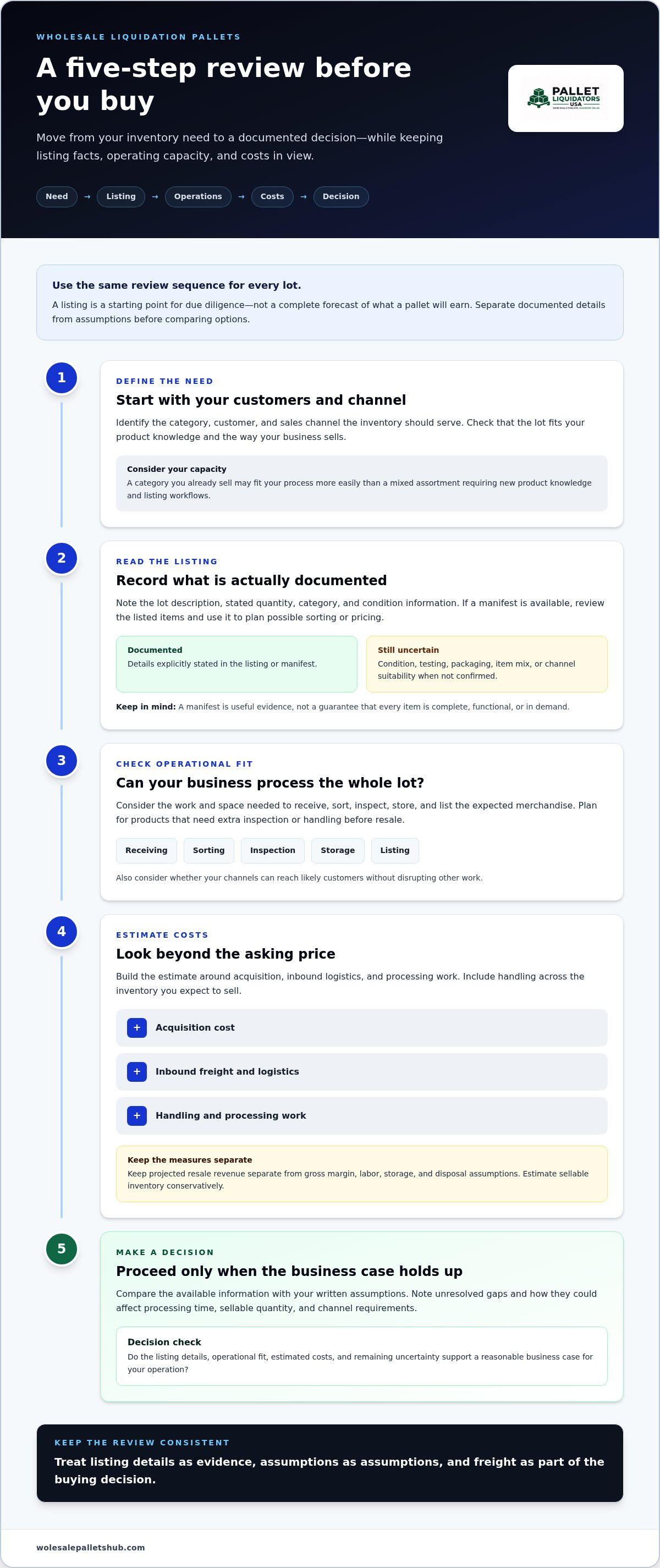
Use the same review sequence for each lot:
- Define the need. Identify the category, customer, and sales channel the inventory should serve.
- Read the listing. Record the lot description, stated quantity, category, and condition information.
- Check operational fit. Consider whether you can receive, sort, inspect, store, and list the expected merchandise.
- Estimate costs. Include acquisition and inbound logistics, then account for processing work.
- Make a decision. Proceed only when the available information and your written assumptions support a reasonable business case.
Which lot details inform a preliminary review?
Start with the stated category and description, then note any quantities and condition details. If the listing includes a manifest, review the listed items and use them to plan how you might sort or price the lot. A manifest can support item-level assessment, but it does not establish that every item is complete, functional, or in demand. Treat the document as useful evidence, not a guarantee of resale results.
Mark what the listing explicitly documents and what you are inferring. An item name, for example, may identify a product type without confirming its packaging, testing status, or suitability for your channel. Record those distinctions so that assumptions do not become facts in your estimate.
How to identify gaps and unresolved assumptions
A broad description or missing detail is an information gap, not proof that the merchandise is poor quality. Note what remains unknown, such as condition, testing, packaging, or the likely item mix. Then consider how each uncertainty could affect processing time, sellable quantity, and channel requirements. This gives you a clearer basis for comparison than treating an incomplete description as either favorable or unfavorable.
Liquidation can occur in different business contexts. The IRS’s guidance on closing a business describes closure-related responsibilities; it does not verify the contents or condition of a resale lot. Keep that distinction clear when using background information to understand why merchandise may enter liquidation channels.
Assess listing details before estimating resale value. The estimate is only as reliable as the documented contents and the assumptions behind it. Use a consistent framework to evaluate liquidation pallets, including the lot’s category, documentation, condition information, and the work needed to prepare goods for sale.
Once your criteria are clear, compare wholesale pallet listings against the category, documentation, and operational requirements you’ve recorded.
Match pallet categories to your resale channel and customer
A merchandise category is useful only if your business can prepare it for the customers you serve. Before comparing wholesale liquidation pallets, consider whether you understand the products, can store and handle them appropriately, and have a practical way to present them through your sales channel. This framework connects broad categories to operational needs; it does not describe the contents of any particular lot.
| Category | Buyer capabilities to consider | Channel considerations |
|---|---|---|
| Tools, hardware, and home improvement products | Product knowledge to describe specifications and distinguish item types accurately. | Consider whether customers can assess the details they need before purchasing. |
| Electronics, phone accessories, and small kitchen appliances | Capacity to handle items carefully, inspect them as appropriate, and prepare clear product information. | Plan for item-level listings and customer questions about condition or included components. |
| Vacuums, cleaning appliances, and household goods | Storage and sorting processes suited to goods that may vary in size and handling needs. | Assess whether your store or online assortment has room for varied household inventory. |
| Apparel and footwear | Ability to sort and organize an assortment for efficient presentation. | Match the merchandise mix to your customers and the way your channel displays items. |
| Sports and fitness goods, fishing equipment, and golf cart accessories | Familiarity with the customer use cases and product details relevant to the category. | Consider whether you already serve buyers seeking these specialty goods. |
Sales-channel fit determines whether a liquidation category becomes useful, manageable inventory or stock that is difficult to describe, store, or move. Use the table to screen categories, then evaluate each specific lot separately.
Choose categories that suit your sales operation
Tools and home improvement goods are a stronger operational fit when your team can communicate product specifications accurately. Electronics and appliances call for a deliberate approach to handling, inspection, and customer-facing information. For apparel, footwear, and sporting goods, consider whether your audience is likely to want the assortment and whether your listing process can present it clearly.
Compare mixed lots with category-focused sourcing
A mixed assortment may broaden your offering, but it can require knowledge across more product types and extra sorting before listing. Category-focused sourcing may be easier to align with an established niche, though it still needs to match customer demand and your capacity. Apply the same criteria to tools, appliances, electronics, apparel, and specialty inventory.
Before committing, compare the expected workload with the people, space, and sales processes available to handle the goods. A category that fits your customers but exceeds your storage or listing capacity may still be a poor operational choice. A familiar category can also be difficult to sell if your channel doesn’t reach its likely buyers. Weigh customer demand, product knowledge, storage, and listing workload together.
Calculate the business case for pallets, including freight and handling
A pallet’s purchase amount alone doesn’t show what it will cost to bring usable inventory into your resale operation. For wholesale liquidation pallets, landed cost means the acquisition cost plus inbound logistics costs, allocated across the inventory you expect to use. Freight can change the economics before the lot arrives, so include it in your evaluation rather than treating it as a later operating detail.
Keep projected resale revenue separate from profit. Revenue is the amount you estimate from sales. Gross margin is what remains after the relevant inventory cost, while labor, storage, handling, and disposal can add further expenses. A worksheet helps keep these assumptions visible and prevents an optimistic sales forecast from standing in for a full cost estimate.
- Acquisition: Record the lot cost and any purchase-related charges that apply.
- Inbound logistics: Enter the freight quote and other shipment costs included in your estimate.
- Usable inventory: Estimate the portion you expect to prepare for sale, and keep uncertain items separate.
- Revenue scenarios: Estimate sales using channel-specific prices, not the listing’s suggested value alone.
- Operating assumptions: Account separately for labor, storage, handling, discounts, and disposal.
Divide acquisition and inbound logistics costs across the inventory you expect to use to calculate a working landed-cost estimate. That figure alone does not determine profitability. Your result still depends on what sells, at what price, and how much work it takes to process the lot.
Estimate a conservative resale case
Base expected selling prices on research for your own channel, such as comparable listings and the prices customers encounter in your chosen marketplace or store. Don’t treat a listed retail value as a forecast of what your business can realize. Make explicit allowances for items that may be unsellable, incomplete, slow-moving, or discounted, and adjust your expected sellable quantity accordingly.
Build conservative, expected, and stronger scenarios by changing your assumptions, not by treating any outcome as certain. For instance, the conservative case might allow for more discounting or slower sales. Compare each scenario with labor and other operating costs included, so a higher projected revenue figure doesn’t hide a weaker margin or a workload your team can’t absorb.
Check freight and operating capacity
Review the freight quote alongside its shipment assumptions, delivery access, and unloading arrangements. A change in inbound cost can alter the landed cost per usable item and make an otherwise attractive lot harder to justify. Confirm that your space, staff time, and handling equipment suit the shipment’s expected size and the work required after delivery.
Keep freight and labor visible in your worksheet before deciding. To compare potential inventory against your operating plan, explore liquidation pallet opportunities and include relevant freight costs in your estimate.
Build a repeatable sourcing process for wholesale liquidation pallets
A repeatable process helps you compare sourcing opportunities against your business needs instead of letting a lot’s headline description set the criteria. Before reviewing listings, document what you intend to sell, who you intend to serve, how you’ll process inventory, and what information you need to decide. Apply the same standards to liquidation pallets, bulk overstock opportunities, and wholesale truckloads.
Create a sourcing brief before comparing lots
Set out your target categories, intended customers, sales channels, and storage constraints in a short sourcing brief. Include internal limits for acceptable information gaps, handling effort, and the share of inventory you could absorb if it proves unsellable. Decide what listing details, manifests when provided, and freight information your evaluation requires. Clear criteria make opportunities easier to compare consistently.
Use the brief to guide a standard workflow:
- Define the inventory need. Specify the category and purpose, such as replenishing an existing assortment or testing a new one.
- Match the category to your operation. Consider customer demand, product knowledge, sales channel, and processing capacity.
- Review the listing. Record stated contents, quantities, condition details, and available documentation. Separate facts from assumptions.
- Plan freight and receiving. Review relevant freight information, delivery access, unloading arrangements, and the space and staff needed to handle the lot.
- Compare the business case. Apply consistent landed-cost and resale assumptions, then decide whether the opportunity meets your own thresholds.
Move from evaluation to a considered purchase
Compare each listing with your sourcing brief, not with a headline merchandise value in isolation. Keep a record of assumptions about usable inventory, resale, landed cost, and your operational plan. If an uncertainty could change your decision, identify it before committing instead of filling the gap with an optimistic estimate.
Save the outcomes alongside your original estimates. Notes on processing effort, item mix, sales-channel fit, and freight planning can help refine your criteria and show where estimates need adjustment. This turns sourcing into a documented business process while leaving room to reassess categories and capacity as your operation changes.
Pallet Liquidators USA supplies liquidation pallets, bulk overstock opportunities, and wholesale truckloads across categories that include tools and hardware, appliances, electronics, apparel, footwear, household goods, and specialty products. Explore wholesale liquidation pallets and inventory options, then compare the lot details and freight costs with your sourcing plan.
Turn a sourcing plan into your next measured step
A sourcing process becomes more useful when you apply it consistently, review what happened after each purchase, and adjust your criteria based on actual handling and sales experience. Your records can help distinguish a promising category from a lot that looks attractive but doesn’t suit your operation. Use each decision to refine how you assess wholesale liquidation pallets, not as a reason to lower your standards.
Pallet Liquidators USA supplies liquidation pallets and wholesale truckloads nationwide, with inventory spanning consumer, home, and specialty categories. Use your sourcing brief to focus on opportunities that align with your customers, processing capacity, and freight plan. Before moving forward, compare the available lot information with your worksheet and identify unresolved factors that could affect your decision.
Review wholesale liquidation pallet opportunities and assess which inventory options fit your resale plan. Explore Pallet Liquidators USA’s wholesale inventory and use your sourcing criteria to choose a suitable next step.
Frequently Asked Questions
Are wholesale liquidation pallets profitable?
Wholesale liquidation pallets can be profitable, but profit isn’t guaranteed. Results depend on sellable contents, customer demand, acquisition and freight costs, processing labor, storage, and whether your sales channels reach likely buyers. Before purchasing, model a conservative case that allows for slower sales or markdowns. Gross revenue is the money collected from sales; net profit is what remains after operating expenses, so don’t treat the two figures as interchangeable.
Do wholesale liquidation pallets always come with a manifest?
No. Documentation varies by lot, so use the information supplied for the specific listing you’re considering. If a manifest is provided, it can help you assess listed items and plan how to process them, but it doesn’t guarantee their condition, completeness, or resale value. Note uncertainties in your evaluation, especially if they could affect your expected sellable quantity or the work required before listing.
Can a small reseller buy wholesale liquidation pallets?
Business size alone doesn’t determine whether a pallet is suitable. Consider whether your working capital, storage, and sorting capacity can accommodate the inventory, and whether your customers and sales channels fit the merchandise. A small reseller with a focused operation may have a clear use for a defined category, while a broader assortment could strain available space or staff time. Start with a specific inventory need and include freight in your assessment.
What should I do if a pallet’s contents differ from my expectations?
Base expectations on the specific listing and accompanying documentation, not on the category label alone. Keep copies of transaction records, listing details, and shipment documentation, then compare the received goods with the terms that applied to your purchase. If you identify a discrepancy, follow the stated process for reporting it and keep clear notes about what differs. The available remedy or outcome depends on the terms applicable to that transaction.
Are liquidation pallets suitable for selling on online marketplaces?
They can be, depending on the merchandise, its condition, listing requirements, and whether shipping each item is practical for your operation. Before sourcing, consider how you’ll describe products accurately, handle customer questions, and fulfill orders through your chosen platform. Review the marketplace’s rules for the relevant product types and brands, since requirements can vary. Don’t assume every item in a lot can be listed or that a platform will approve a particular product.
What information should I have before requesting a freight quote for liquidation pallets?
Have the specific lot and shipment details for that order, along with information about delivery access and unloading arrangements. Compare the quote’s assumptions with the space, equipment, and staff you’ll have ready to receive the goods. Include quoted inbound logistics in your landed-cost estimate before deciding whether the lot fits your plan. Avoid relying on a quote based on different shipment details.
Can liquidation pallets include damaged or incomplete products?
Yes, merchandise condition can vary, so use the condition information supplied for the individual lot rather than assuming all items are ready for resale. In your purchase model, allow for items that may need additional inspection, discounting, repair, or disposal. Base those assumptions on the listing and any accompanying documentation; don’t infer a particular condition mix from the category name. This helps you evaluate the work involved before the inventory arrives.
