

A condition grade is a starting signal, not a resale guarantee. Liquidation pallet condition grades can help you estimate what a lot may contain, but the same label can mean different things across sellers. “Grade A” alone doesn’t tell you whether items were tested, are complete, or suit your resale channel.
That uncertainty matters when your buying plan depends on sellable units, inspection time, and possible repair work. Labels such as new, shelf-pull, customer return, Grade B or C, and salvage suggest different handling needs, but none replaces a review of the specific lot details.
This guide explains how to interpret common condition labels, what to check beyond the grade, and how to match inspection needs to your resale operation. Examples from tools and hardware, small appliances, electronics, apparel, and household goods show why you should assess condition and product type together before committing to inventory.
Key Takeaways
- Use liquidation pallet condition grades as broad indicators, then read the lot description to understand what a label means for that inventory.
- Distinguish a condition grade from a manifest: listed contents or quantities don’t necessarily establish an item’s completeness or functionality.
- Assess a lot against your resale channel and capacity for testing, cleaning, repairs, and sorting.
- Identify gaps in the listing before purchase, then plan the inspection steps needed to evaluate inventory responsibly.
- Compare lot details with your operating capacity when evaluating liquidation pallets, wholesale truckloads, and bulk overstock opportunities from Pallet Liquidators USA.
What Do Liquidation Pallet Condition Grades Mean?
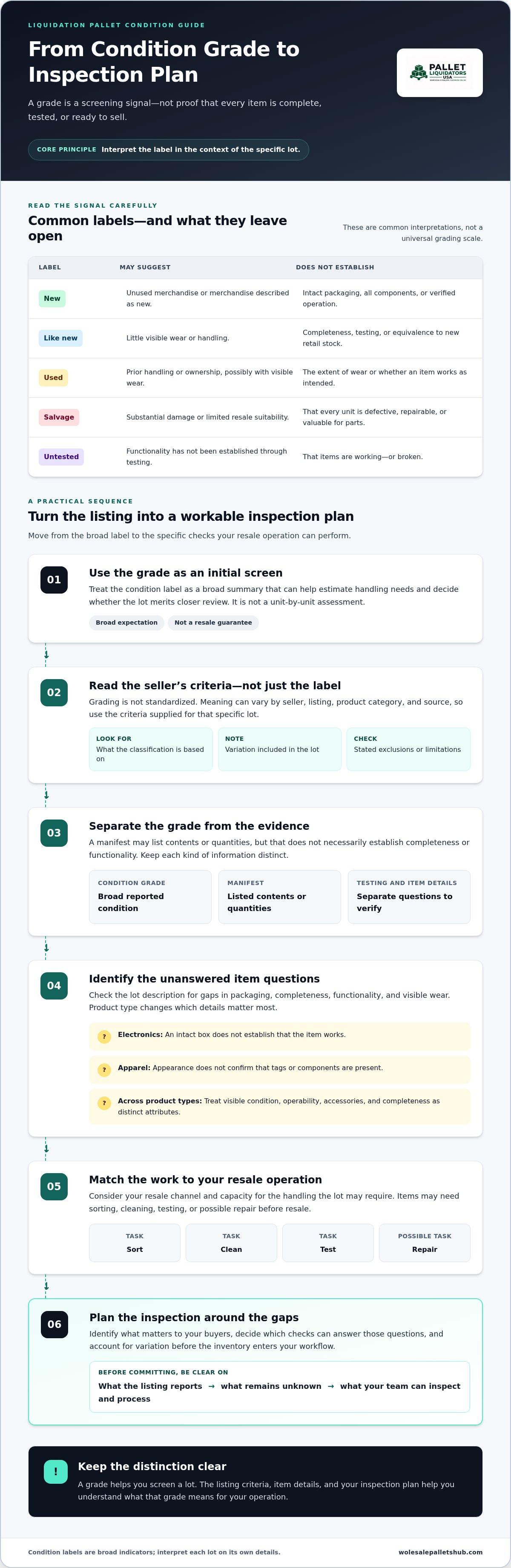
A condition grade summarizes the reported condition of merchandise at a broad level. It gives resellers an initial way to screen a lot, estimate the work it may require, and decide whether the inventory merits closer review. The label isn’t a unit-by-unit assessment. It may leave questions about functionality, completeness, packaging, and visible wear unanswered.
A grade’s meaning can vary by seller, listing, product category, and source. A label applied to apparel may not capture the same practical concerns as one applied to electronics or power tools. Read each term in context and use the criteria in that lot’s description instead of assuming a familiar label has a fixed definition.
Used carefully, liquidation pallet condition grades help buyers compare broad inventory expectations and prepare an inspection plan. They can inform estimates of sorting time, cleaning, testing, or possible repair, but they can’t tell you in advance which individual units will suit a particular resale channel. A grade is a screening signal, not proof that every item is ready to sell.
For example, a listing may summarize a pallet even though individual products vary in packaging, completeness, or visible wear. An intact box doesn’t establish that an electronic item works. A garment’s appearance doesn’t confirm that its tags or components are present. These are separate inspection questions, and a broad grade may not answer them all.
Why condition labels matter to liquidation buyers
Condition expectations affect how inventory moves through your operation. Items that need only sorting may suit a channel that accepts varied merchandise. Products that require testing, cleaning, or repair need more labor before resale. A pallet-level summary can help you anticipate those tasks, but it isn’t a verified condition report for every unit. Account for variation when deciding what your team can process.
Are liquidation pallet grades standardized?
No. There isn’t one universal grading scale used by all liquidation sellers. Familiar terms can have seller-specific definitions, and the inspection methods behind a label may differ or may not be described. Interpret the grade using the criteria in the listing, then note what those criteria leave unanswered. This helps separate reported information from your own assumptions.
The grade is one part of the inventory description, not a substitute for lot-level details. Look for language explaining the basis of the classification, the types of variation included, and any stated exclusions or limitations. If the listing gives only a broad label, include that uncertainty in your assessment rather than borrowing another seller’s definition.
This approach applies across mixed bulk inventory, including household goods, small appliances, footwear, and tools, where the condition questions differ by product type. Identify what matters to your buyers, decide which checks can answer those questions, and use the grade to guide your next step. That gives you a more realistic estimate of handling needs before inventory enters your workflow.
Common Liquidation Pallet Condition Grades and Their Limits
The labels below are common market terms, not a universal scale. Treat each as a possible interpretation, then use the lot listing’s criteria to understand what the seller means. This matters when comparing pallets from different sources: similar wording doesn’t necessarily indicate the same inspection process or inventory expectations.
| Label | What it may suggest | What it doesn’t establish |
|---|---|---|
| New | Merchandise described as unused or in new condition | That every unit has intact packaging, all components, or verified operation |
| Like new | Items that may show little visible wear or handling | That items are complete, tested, or equivalent to new retail stock |
| Used | Previously handled or owned merchandise, possibly with visible wear | The extent of wear or whether an item works as intended |
| Salvage | Inventory that may have substantial damage or limited resale suitability | That every unit is defective, repairable, or valuable for parts |
| Untested | Items whose functionality has not been established through testing | That items are working or broken |
What new, like-new, and used can suggest
In general usage, “new” may indicate unused merchandise, “like new” may point to minimal visible wear, and “used” may signal prior handling or use. These are interpretations, not guaranteed definitions. Packaging, cosmetic wear, and handling history can all influence how a seller applies each term. Before comparing two lots with the same label, read both descriptions and note how each defines the condition.
A favorable label doesn’t establish resale value, either. A product may look new but lack an accessory that matters to its buyer. An item described as used may still suit a channel that accepts visible wear. Evaluate product requirements and customer expectations rather than treating the label as a forecast of sell-through or price.
How to interpret salvage and untested labels
“Salvage” can signal substantial damage or limited suitability for resale as-is, but it doesn’t mean every unit is damaged or that any unit can be repaired. “Untested” describes a gap in functional assessment, not a confirmed working or defective status. Keep those terms separate and evaluate visible condition, operability, included accessories, and completeness as distinct attributes.
For example, a clean exterior doesn’t confirm that an electronic device powers on, and an untested item shouldn’t be assumed either functional or unusable. For apparel or household goods, completeness and cosmetic condition may matter more than powered operation. Match each lot’s uncertainty to your capacity to sort, inspect, and handle exceptions.
These distinctions are useful when reviewing wholesale pallet inventory options: read the lot-specific wording before making assumptions based on a label. Condition labels describe broad expectations, while item-level outcomes can vary.
How Condition Grades Compare With Manifests, Testing, and Item Details
A condition grade summarizes reported merchandise condition. A manifest, when provided, may identify products or quantities associated with a lot. These documents answer different questions: the grade offers a broad condition signal, while the manifest helps you understand what inventory is represented. Neither automatically confirms that every listed unit is present, complete, or functional.
For a practical evaluation, compare the grade with the evidence available for that lot. Item-level photos, descriptions, testing notes, and quantity details can reduce uncertainty, but each supports only the claims it documents. A photo may show exterior appearance without demonstrating operation, while a product name on a manifest doesn’t establish that all accessories are included. Treat each detail as separate evidence.
What a manifest can and cannot establish
A manifest is lot documentation, and its detail and accuracy depend on what the listing provides. Product names and quantities can support preliminary sorting plans, category estimates, and decisions about whether inventory fits your resale operation. They don’t prove that every listed unit will be present or operational. Compare manifest entries with the lot description, and record any assumptions you’ll need to verify after receipt.
Why inspection and testing details matter separately
Testing status, packaging, visible damage, accessories, and completeness are distinct data points. The evidence available can vary by lot and sales process, so don’t read more into a grade or document than it states. Understanding how manifested and unmanifested lots differ can also help you assess what information is available before purchase.
Use a simple evidence check as you review listing materials:
- Product and quantity: Note what the manifest names and how quantities are presented.
- Condition evidence: Separate the broad grade from item-specific descriptions or photos.
- Functionality: Look for explicit testing information. Don’t infer operation from appearance or packaging.
- Completeness: Check whether accessories or components are described instead of assuming they’re included.
This comparison is especially useful in categories where one missing detail can change the work required. For an appliance, exterior condition and functional testing are separate questions. For footwear, visible appearance doesn’t necessarily establish that pairs are complete. A listing may provide useful evidence on one point and leave another unresolved.
As you evaluate liquidation pallet condition grades, record the grade, manifest, and inspection evidence separately. Then identify what each source supports, what remains unknown, and what your operation would need to inspect or test. This prevents a broad label or product list from being mistaken for a complete condition assessment, and gives you a more grounded basis for planning sorting and resale.
How to Use Condition Grades in a Resale Risk Assessment
Use a grade to frame your evaluation, then decide whether the lot’s likely processing demands fit your business. The same mixed-condition inventory may work for a reseller with space, testing capability, and several sales channels, but create bottlenecks for an operation with limited labor or storage. Assess your capacity alongside the listing, not after the pallet arrives.
- Define your resale channel. Consider customer expectations, how you’ll disclose item condition, and the potential for returns or disputes. A channel suited to clearly described used goods may tolerate more variation than one where buyers expect products to be ready for immediate use.
- Interpret the listing on its own terms. Read the seller’s definition of the grade and the lot description. Don’t carry assumptions over from another seller or category. A condition label may not describe the same handling history across tools, apparel, or household goods.
- Identify evidence gaps. Separate information provided from what remains unknown, including functionality, completeness, quantities, packaging, or visible damage. Treat an unaddressed point as an assumption in your risk assessment, not an implied fact.
- Plan inspection and processing. Decide how you’ll sort, test, clean, repair, and document inventory. Estimate whether your staff, workspace, and storage can accommodate the work.
Match the grade to your resale channel
Compare the lot with your customers’ condition standards and the disclosures your sales process allows. Electronics may need testing before you can describe how they operate; apparel may need sorting for wear and completeness. A mixed lot can suit a business equipped to classify items and route them to different channels, but may be a poor fit if every unit must meet one narrow resale standard. Include labor and storage limits in your decision.
Turn the listing into an inspection plan
Translate the listing into separate checks for product condition, quantity, testing status, packaging, and accessories. When you can inspect items before purchase, review representative products across categories and record exceptions rather than relying on one item to represent the whole lot. For small appliances, note exterior condition separately from operating checks. For tools, track included components separately from visible wear.
Use a pallet-evaluation checklist to organize your review, and connect the findings to your unit economics by accounting for the work needed to make inventory saleable. A grade alone can’t show whether your operation has enough capacity for that work. Keep uncertain items separate in your estimates instead of counting them as ready-to-sell units.
Once your inspection requirements and channel fit are clear, compare them with the lot details before committing. Browse liquidation pallet inventory with your resale criteria in mind, including the categories your team can process and the level of condition variation it can absorb.
Source Liquidation Pallets With Condition Expectations in View
Use a condition grade as one input in a purchasing decision, alongside the lot-specific description and your operation’s capacity to sort, inspect, and prepare inventory. The label can help set an initial expectation, but it shouldn’t determine whether a lot fits your business on its own. Consider the products involved, the evidence in the listing, and the work your team can realistically absorb before comparing sourcing options.
Apply the same condition framework across product categories
Inspection priorities change with the merchandise. Apparel may call for checks of wear, stains, sizing, or tags, while tools and small appliances may require attention to operation and included components. Electronics, footwear, and household goods also raise distinct questions about function, completeness, and cosmetic condition. A broad pallet label doesn’t replace product-level assessment or tell you which checks matter most for a category.
Build category-specific expectations into your buying process rather than applying one assumption across a mixed lot. Decide which items need functional testing, which can be sorted visually, and which require a closer review for missing parts or damage. Then consider whether you have the space, labor, and resale channels to handle different outcomes. This makes it easier to assess liquidation pallet condition grades in practical terms, without treating the same wording as equally informative for every product type.
Explore wholesale inventory with a practical buying framework
Pallet Liquidators USA supplies liquidation pallets, wholesale truckloads, and bulk overstock opportunities to resellers and businesses nationwide. Its inventory includes tools and hardware, appliances, electronics, apparel, footwear, sporting goods, and household products. Evaluate each lot on its own condition details and listing information.
As you review wholesale inventory, apply the same questions to each listing: what does its condition language state, which lot details support that description, and can your operation process the likely range of outcomes? Compare the answers with your resale channel and handling capacity, then account for unresolved details in your purchase assessment. A disciplined review keeps expectations connected to the listing rather than to assumptions attached to a familiar label.
Explore wholesale liquidation inventory and assess lot information against your category needs, inspection approach, and operating capacity.
Set a Clear Standard for Your Next Purchase
Before evaluating another lot, set a practical threshold for what your team can process: which details must be documented, what level of uncertainty you can absorb, and how much inspection work fits your workflow. Applying that standard consistently makes future buying decisions easier to compare and reduces reliance on assumptions about familiar labels. Use liquidation pallet condition grades as a prompt for further evaluation, not as a substitute for the criteria your business needs.
Pallet Liquidators USA supplies liquidation pallets and wholesale truckloads nationwide, with inventory categories that include tools, appliances, electronics, apparel, footwear, sporting goods, and household goods. Compare lot information with your category focus and operating capacity as you assess wholesale sourcing options.
Explore wholesale liquidation inventory and evaluate lots against your team’s inspection plan, resale channel, and processing capacity.
Frequently Asked Questions
Are liquidation pallet condition grades standardized?
No. Liquidation pallet condition grades don’t follow one universal scale, so a label’s meaning depends on the seller’s stated criteria and the lot description. For example, two listings may both use “like new” while describing different packaging or inspection practices. Compare the wording and disclosed evaluation basis in each listing rather than assuming matching labels make two lots equivalent.
What does Grade A mean on a liquidation pallet?
Grade A often suggests merchandise in relatively good or like-new condition, but the term doesn’t have a fixed meaning across sellers. A listing might use it to describe appearance, handling history, or another broad condition assessment. For example, a favorable appearance label on a pallet of electronics still doesn’t tell you whether devices were powered on. Use the listing’s own explanation to interpret the grade.
Does a liquidation pallet grade guarantee that the items work?
No. A condition grade alone doesn’t guarantee that items function. A product can have clean packaging or limited visible wear and still have an operational issue, while an item with cosmetic wear may work properly. Treat functionality as a separate question, particularly for electronics, tools, and appliances. If the listing doesn’t specify testing, don’t count unverified items as confirmed working inventory in your resale estimates.
What is the difference between a condition grade and a manifest?
A condition grade summarizes reported merchandise condition; a manifest describes listed inventory, which may include product names and quantities. A manifest can help you anticipate sorting needs, but it doesn’t independently verify that each listed unit is present or functional. For planning, compare listed quantities with the descriptions and use the product mix to prepare category-specific checks instead of treating the document as a complete inspection record.
What does untested mean on a liquidation pallet?
“Untested” means the item’s operation hasn’t been established through testing; it doesn’t confirm that the item works or is defective. For a small appliance, that means allowing time and space for a functional check before deciding how to list it. Keep untested stock distinct from verified inventory in your records, so sales descriptions and expected sellable quantities don’t assume a result you haven’t established.
Can one liquidation pallet contain items in different conditions?
Yes. A pallet-level label may cover a group of products whose individual condition varies. A mixed household-goods lot, for instance, could include items with different packaging, visible wear, or missing components. Plan your sorting process to classify units individually when resale decisions depend on their condition. This also helps separate items suited to one sales channel from those that need additional handling or a different disposition.
How should resellers choose liquidation pallets by condition grade?
Start with your resale channel and the condition your customers will accept, then compare those expectations with the lot description and your capacity to process exceptions. A reseller equipped to test electronics may assess an untested lot differently from a business that cannot perform those checks. Consider labor, storage, and the time needed to sort or prepare inventory. Choose based on the full workflow, not the grade alone.

