

What if the biggest liquidation pallet inventory risks begin after the pallet arrives? A purchase may look manageable on paper, but uncertain condition, missing components, freight and handling demands, and limited storage can create more work than your resale operation can absorb. Even saleable items may take longer to process and sell than your cash flow or sales channels allow.
The purchase price alone doesn’t tell you whether a pallet fits your inspection capacity, sales channels, or available space. Risk can build when condition issues slow processing, extra handling consumes labor, or slow sales leave working capital tied up in inventory.
This article explains where those risks arise and how to assess them before committing. Use the practical checks below to compare merchandise category, available lot information, freight, storage, processing demands, and resale suitability with your operation’s actual capacity.
Key Takeaways
- Separate the variability inherent in a lot from risks you can reduce through preparation and careful review.
- Consider how inspection and sorting can delay listings, occupy storage, and slow other work.
- Match category-specific handling and storage needs to the sales channels you already use.
- Assess your capacity, available lot information, expected workload, and remaining exposure before committing to liquidation pallet inventory risks.
- Check that mixed inventory fits your available labor and space before adding it to your operation.
Liquidation Pallet Inventory Risks: What Buyers Need to Understand
Inventory risk is the possibility that goods won’t meet your expectations for condition, completeness, usability, or resale suitability. With liquidation pallets, uncertainty can affect both what you can list and how much work you need to do before an item is ready for sale. Some variation is inherent in a lot; you can reduce other exposure with preparation, realistic cost estimates, and a clear handling plan.
Liquidation inventory risk is the chance that acquired goods will require more inspection, processing, space, or selling effort than your plan and resources can accommodate. This differs from conventional replenishment, where buyers may restock known products with consistent specifications and repeatable listing details. A liquidation lot may include surplus or returned goods, and the available information may not establish that every item is complete, usable, or ready to sell. That variability doesn’t prove poor quality. It means you shouldn’t treat estimated resale value as confirmed, immediately saleable stock.
Why liquidation inventory is not identical to conventional replenishment
With conventional replenishment, repeat purchases of standardized items can make it easier to estimate listing work and buyer demand. A liquidation lot may have a different mix or require item-by-item assessment. An appliance, for example, may need a completeness check, while apparel may need sorting by size and condition. These are possible workload differences, not guarantees about a particular lot.
Inventory management involves tracking, forecasting, and controlling stock, as outlined in Inventory Management Principles. For liquidation buyers, that means distinguishing a listed or estimated value from inventory that has been inspected, classified, and matched to a workable sales channel. A low acquisition price alone doesn’t establish commercial value. You also need to consider what your operation can process and sell with its available resources.
Where a pallet purchase can create exposure
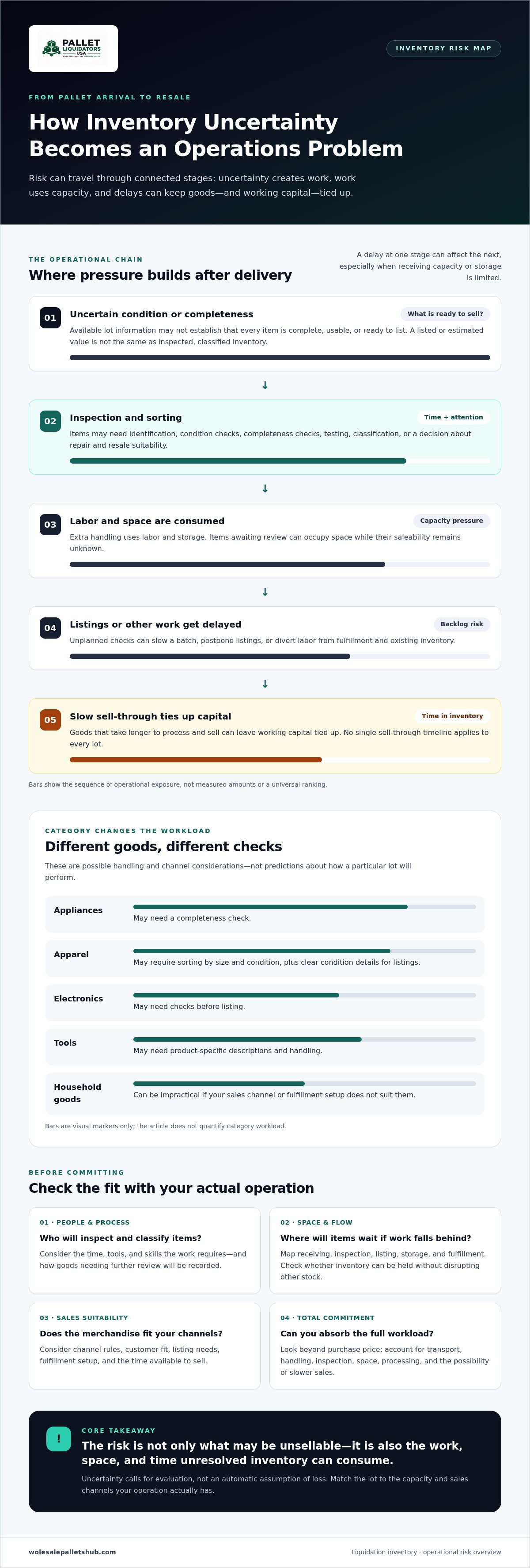
Risk often builds across connected stages. Uncertain inventory can add inspection and sorting time. Extra handling uses labor and space. Transport adds to the total commitment, while slower sell-through can leave capital tied up in goods awaiting buyers. A delay at one stage can affect the next, especially when receiving capacity or storage is limited.
The type and level of risk depend on the lot, your capacity, and the intended resale channel. A familiar category may be easier to assess than unfamiliar merchandise, and the same lot may suit one channel better than another. Before counting on resale, ask whether you can receive, inspect, store, list, and fulfill the goods. Uncertainty calls for evaluation, not an automatic assumption of loss.
How Inventory Uncertainty Becomes a Resale and Operations Problem
You may not know the full operational burden until the goods arrive and you assess them. If an item’s condition or completeness is uncertain, you may need to identify it, inspect it, separate it from other items, and decide whether it suits your sales channel. Each task takes time away from listing, fulfillment, or work on existing inventory.
Condition and completeness create processing demands
Inspection may uncover damage, missing parts, or items that aren’t suitable for resale in their current condition. Depending on the merchandise, you might need to test an item or decide whether repair is practical. Neither task is necessary for every lot. The planning risk is underestimating the workload: if you have allowed time only for sorting and listing, additional checks can slow the whole batch.
Base your processing plan on the workflow you can actually run. Decide who will inspect and classify items, what tools or skills the work requires, and how you’ll record goods that need further review. Without a consistent process, items can sit unresolved, taking up space while their saleability remains unknown.
Sell-through and capacity determine what happens next
Even usable merchandise can be difficult to move if it doesn’t suit your sales channels or customers. Tools may need product-specific descriptions and handling. Apparel may require sorting and clear condition details. Electronics may need checks before listing. Household goods may be impractical if your channel or fulfillment setup doesn’t suit them. These are channel considerations, not predictions about how any category will perform.
Inventory uncertainty compounds when inspection delays processing, processing consumes capacity, and limited capacity postpones listings or sales. The result may be occupied storage, a backlog of unlisted items, or labor diverted from other work. No single sell-through timeline applies to every lot. Demand, listing quality, pricing decisions, channel rules, and available time can all affect how quickly goods move.
Before committing, map the steps from receiving through inspection, listing, storage, and fulfillment. Identify where items will wait if the next step falls behind, and whether you can hold them without disrupting other inventory. This makes liquidation pallet inventory risks easier to assess: the concern isn’t only that an item may be unsellable, but also that unresolved work can consume resources and delay other tasks.
Use category and volume to assess capacity, not just to express a purchasing preference. Reviewing wholesale pallet inventory alongside your available labor, space, and sales channels can help you define what your operation is equipped to process. This won’t remove uncertainty, but it can reveal potential bottlenecks before the inventory reaches your warehouse.
How Category, Freight, and Handling Change Liquidation Inventory Risk
Merchandise category affects what you need to consider before inventory can move through receiving, inspection, and resale. Category alone doesn’t establish a pallet’s condition or commercial value. Use it to guide questions about handling, available space, and whether your current sales channels can support the work involved.
Compare handling demands across merchandise categories
These are planning questions, not predictions about a specific pallet. Actual requirements depend on the items, their condition, lot information, and your workflow. Compare each category with the labor and resources you can allocate.
| Category | Handling question | Storage need to assess | Resale-channel fit to assess |
|---|---|---|---|
| Tools | Will inspection or functional testing be needed before listing? | Can you organize and protect items while they await review? | Can your channel support clear item details and any relevant condition information? |
| Appliances | Can you assess condition and completeness, and determine whether testing is practical? | Do the items fit your available staging and storage space? | Does your channel and fulfillment process suit the items’ size and handling needs? |
| Electronics | What checks are needed to assess condition, completeness, and listing suitability? | Can you store items securely and keep them organized during inspection? | Can you provide the item details and condition information buyers need? |
| Apparel | How will you sort items and assess condition before creating listings? | Is there room to sort and hold inventory without mixing classifications? | Can your channel accommodate the descriptions and organization your listings require? |
| Footwear | How will you assess condition and completeness for individual pairs? | Can you keep pairs organized during review and storage? | Can your channel present item-specific information clearly? |
| Sporting goods | What inspection or completeness checks suit the specific items? | Do item dimensions and handling requirements fit your storage setup? | Does your channel reach buyers for the merchandise you can prepare? |
For household goods, assess size, fragility, and staging needs as well. These are factors to investigate, not reasons to assume every item requires special handling or carries greater risk. Category differences matter to liquidation pallet inventory risks because they can change the work and space required before resale.
Include freight and receiving in the risk picture
Transport is part of the inventory workflow, not a separate consideration from processing. Before purchasing, plan how the shipment will reach your receiving area, who can unload it, and where you can stage it for inspection. Consider site access, unloading arrangements, available equipment and labor, and whether receiving the lot will disrupt other work.
Limited staging space can delay sorting, while insufficient receiving capacity can create a bottleneck before inspection begins. Include these constraints and your transport arrangements when estimating the total operational commitment. Don’t assume a particular freight rate or handling charge.
For broader sourcing context, the wholesale liquidation pallets buying guide can help frame purchasing decisions. Apply the same discipline to category, freight, and receiving: identify the questions that matter to your operation, then assess the lot against the space, labor, and sales channels you can support.
A Practical Framework for Controlling Liquidation Pallet Inventory Risk
A repeatable review can’t eliminate every unknown, but it can show whether a lot fits your operation before you commit. Work through the steps below and separate what you can assess from what remains uncertain. If your decision depends on assumptions about unseen contents, condition, or future resale, pause and reassess rather than treating those assumptions as facts.
Set limits before assessing a lot
First define the resources you can commit: budget, available labor, storage, receiving capacity, and sales channels. Then compare the lot’s category and volume with the people, equipment, and time you have to inspect, sort, prepare, list, and fulfill inventory. Setting limits first helps prevent an appealing estimate from pushing your operating plan beyond its capacity.
- Define capacity. Record how much working capital and space you can allocate, who will handle processing, and how much time can be diverted from existing work.
- Review available lot information. Note what is documented about category, contents, and condition. Separate those details from estimates and assumptions. Treat missing information as unknown, not as proof that items are complete or ready to sell.
- Estimate workload. Map receiving, inspection, sorting, testing where appropriate, listing, and fulfillment. Consider where items will wait if any step takes longer than planned.
- Assess exposure. Compare the purchase commitment and expected operating demands with conservative resale assumptions. If the lot only makes sense if every item is usable or sells through one particular channel, revisit the decision.
Use this liquidation pallet evaluation checklist alongside your capacity limits for more detailed pre-purchase checks. A checklist can make your review more consistent, but it can’t establish facts about contents or future demand that aren’t available to assess.
Document assumptions and review outcomes
Keep a consistent record for each purchase: available lot information, working estimates, inspection findings, processing effort, and your decision to proceed or pass. After receiving the inventory, compare its actual condition and workload with your assumptions. Over time, this turns estimates into useful operational evidence rather than one-time calculations.
Separate checks you can control from uncertainty that remains. You can review the available information, examine accessible items, plan staffing and space, and assess channel fit. You may still be unable to establish every item’s condition or saleability before purchase, or predict how quickly buyers will respond. Identify that remaining exposure and decide whether it fits your tolerance.
Use repeated differences between estimates and results to adjust future category and volume choices. If inspection regularly takes more staff time than planned, revise your workload estimate or choose a volume your team can process. This disciplined approach helps manage liquidation pallet inventory risks without assuming either a favorable outcome or an inevitable loss. Once your limits and review process are clear, explore liquidation pallet options that fit your defined capacity.
Match Liquidation Inventory to Your Resale Operation Before Buying
A suitable lot is more than merchandise that seems relevant to your business. Its category, processing requirements, and volume need to fit how you receive, prepare, and sell inventory. Pallets and wholesale truckloads are sourcing formats, not guarantees of specific contents, resale readiness, or commercial results. Assess each option against your operation instead of assuming a larger quantity creates a better opportunity.
Assess operational fit for your business model
Start with the channels you already manage. A retail store may have display space but limited capacity for detailed online listings. An online seller may be set up to create detailed listings but lack room to stage bulky inventory. A discount-store operation may suit a broad assortment if its staff and storage can handle the categories involved.
Knowing a category doesn’t replace a workload assessment. Consider whether your team can inspect, sort, describe, and fulfill the merchandise with its current skills and equipment. If a lot includes categories your business rarely handles, account for the extra learning and classification work instead of assuming it will fit your existing workflow.
Turn risk awareness into a sourcing decision
Classify the exposure before deciding. Some risks may fit your normal operating tolerance; others can be reduced with preparation, documented review, or a narrower purchasing scope. Uncertainty may remain, especially when lot information doesn’t establish each item’s condition or how quickly it will sell. No category or format is automatically unsuitable, but unresolved assumptions shouldn’t be treated as confirmed value.
- Acceptable: Variability you can accommodate with your available staff, space, and working capital.
- Reducible: Exposure you can address with clearer assumptions, inspection planning, or a better match to your sales channels.
- Unresolved: Unknowns that remain after review and should be reflected conservatively in your decision.
Compare opportunities using the same written criteria: category familiarity, information available, expected processing effort, storage needs, channel fit, and remaining uncertainty. This makes lots easier to compare and helps prevent optimistic resale assumptions from driving the decision. If the volume exceeds what your operation has shown it can process, consider a smaller commitment or wait until capacity changes.
Managing liquidation pallet inventory risks means matching the opportunity to your actual business model, not trying to eliminate every unknown. Continue your sourcing research by exploring wholesale liquidation inventory with your documented requirements in mind.
Make Your Next Sourcing Decision With Clearer Limits
Use your assessment as a working boundary, not a formality. If expected processing demands exceed your current capacity, adjust the volume or choose a category your operation can handle more readily. If important assumptions remain unverified, account for the uncertainty instead of relying on an ideal resale scenario. This keeps liquidation pallet inventory risks tied to manageable business decisions rather than letting them disrupt your workflow after the inventory arrives.
As you source, compare pallets, wholesale truckloads, and bulk overstock opportunities with the channels, storage, and labor you can support. Options can include tools, appliances, electronics, apparel, footwear, sporting goods, and household goods. Assess each on its own terms rather than assuming one format or category will suit every reseller.
When you’re ready to source with your operating limits in mind, explore wholesale liquidation inventory from Pallet Liquidators USA, which supplies liquidation pallets, wholesale truckloads, and bulk overstock opportunities to resellers and businesses.
Frequently Asked Questions
Do liquidation pallets guarantee a resale profit?
No. Revenue depends on what the lot contains, item condition, preparation requirements, the sales channel, and your operating costs. A projected retail value isn’t money received, and it may not reflect what buyers will pay for items in their actual condition. To assess liquidation pallet inventory risks, build conservative scenarios that account for freight, labor, platform charges, and items that may not be suitable to list.
Can liquidation pallets contain damaged or incomplete items?
Yes. Item condition can vary, and inspection may reveal damage, missing components, or goods that need further assessment before resale. For example, you may need to set aside an item for a parts check while preparing other goods for listing. The workload depends on the lot and available information. Plan a receiving process that records each item’s status instead of moving unreviewed goods directly into saleable stock.
Is a liquidation pallet manifest a guarantee of its exact contents?
No, not by itself. A manifest describes listed inventory, but its meaning depends on the document and the written terms of the transaction. Check how items are identified, whether quantities are stated, and what the terms say about discrepancies. Keep a copy with your purchase records. After delivery, compare the goods with the document and record differences promptly, so any follow-up is based on specifics rather than memory.
What happens if liquidation inventory does not sell?
Slow-moving goods can occupy space and continue to require attention without generating sales. Depending on the merchandise and your channel, you may need to revise listings, adjust prices, bundle items, or decide whether continued storage is practical. Before buying, decide who will make those calls and how much storage you can allocate. Don’t plan around a single expected selling pace, since demand and channel response can vary.
Can liquidation inventory include recalled products?
It’s possible for products in secondary markets to raise recall or safety questions. Don’t assume an item is suitable for resale simply because it arrived in a pallet. Use identifying information to check relevant official recall sources and review requirements that apply to the product and jurisdiction. If the status or applicable obligations are unclear, seek qualified guidance before offering the item for sale. Keep your review records with the inventory documentation.
Are liquidation pallet purchases refundable?
Refund and dispute terms vary by seller, transaction, and written sale conditions, so review the applicable terms before purchasing. Keep the listing or lot description, payment confirmation, delivery records, and related correspondence together. If the received inventory appears inconsistent with the transaction documents, note the specific items and condition promptly, then follow the process set out in the sale terms. Don’t assume a refund applies without reviewing those conditions.
How much unsellable inventory should a reseller expect?
There isn’t one dependable percentage for every pallet. The share that can’t be resold depends on factors such as lot composition, item condition, and how you define saleable inventory. Instead of relying on a generic recovery rate, model several outcomes, including a lower-than-expected share of listable goods. Also account for the time needed to identify items that can’t be sold and decide whether your operation can absorb that result.


